
Yes, air purifiers can help reduce many common household odors, including pet smells, cooking odors, smoke, and some chemical fumes. However, they are most effective when equipped with activated carbon filters. HEPA filters alone are designed to capture particles and do not remove odors effectively.
Air purifiers can improve indoor air quality and reduce odors by removing the particles and gases that contribute to unpleasant smells. However, not all air purifiers are equally effective for odor removal.
Models that use activated carbon filters are typically the best choice because activated carbon absorbs odor-causing molecules rather than simply trapping airborne particles.
To eliminate persistent smells faster, ensure your air purifier has a high CADR (Clean Air Delivery Rate) and run it at maximum speed initially.
| Filter Type | Removes Smells? |
|---|---|
| HEPA Filter | No |
| Activated Carbon Filter | Yes |
| Pre-Filter | Limited |
| UV Filter | No |
| Ionizer | Limited |
HEPA filters are excellent at capturing airborne particles such as dust, pollen, pet dander, and mold spores. However, they do not effectively remove odors because odor molecules are much smaller than the particles HEPA filters are designed to capture.
Activated carbon filters are specifically designed to absorb gases, smoke, VOCs, and odor molecules. If your main concern is smell removal, an activated carbon filter is the most important feature to look for.
Air purifiers can help reduce a variety of common household odors, including:
Pet smells often come from dander, fur, saliva, litter boxes, bedding, and accidents. A purifier with both HEPA and activated carbon filtration can help reduce many of these odors.
Strong cooking smells from fried foods, fish, spices, and burnt food can linger for hours. Carbon filtration helps capture many of the gases responsible for these odors.
Smoke is one of the most challenging odor sources because it contains both particles and gases. Air purifiers with substantial activated carbon filtration generally perform best.
Musty smells are often associated with excess moisture, mildew, or mold. While an air purifier may help reduce airborne particles and odors, it cannot solve the underlying moisture problem.
Paint fumes, cleaning products, adhesives, and new furniture can release volatile organic compounds (VOCs). Some air purifiers can help reduce these compounds, especially models designed specifically for VOC removal.
Not all odors are equally easy to eliminate. Air purifiers generally do a good job reducing common household smells such as pet odors, cooking odors, and light smoke odors, especially when equipped with activated carbon filtration.
However, some odors are much more challenging. Heavy cigarette smoke, strong chemical fumes, sewer odors, and persistent mold smells often indicate an ongoing source that continues releasing odor-causing gases into the air. In these situations, even a high-quality air purifier may provide only limited improvement if the underlying problem is not addressed.
For example, a purifier may help reduce a musty smell in a damp room, but it cannot fix the moisture issue causing mold growth. Likewise, sewer odors are usually a sign of a plumbing problem that requires repair rather than additional air filtration. For the best results, removing the source of the odor is often just as important as running an air purifier.
| Odor Source | Can an Air Purifier Help? |
|---|---|
| Pet Odors | Yes |
| Cooking Smells | Yes |
| Cigarette Smoke | Yes |
| Wildfire Smoke | Yes |
| Cat Litter Odors | Yes |
| Paint Fumes | Yes |
| Gas Leaks | No |
| Sewage Odors | Limited |
| Active Mold Problems | Limited |
The amount of time depends on:
Light odors may improve within a few hours, while heavy smoke or strong pet odors may take several days of continuous use.
Several factors influence how effectively an air purifier removes odors:
Larger activated carbon filters generally absorb more odors.
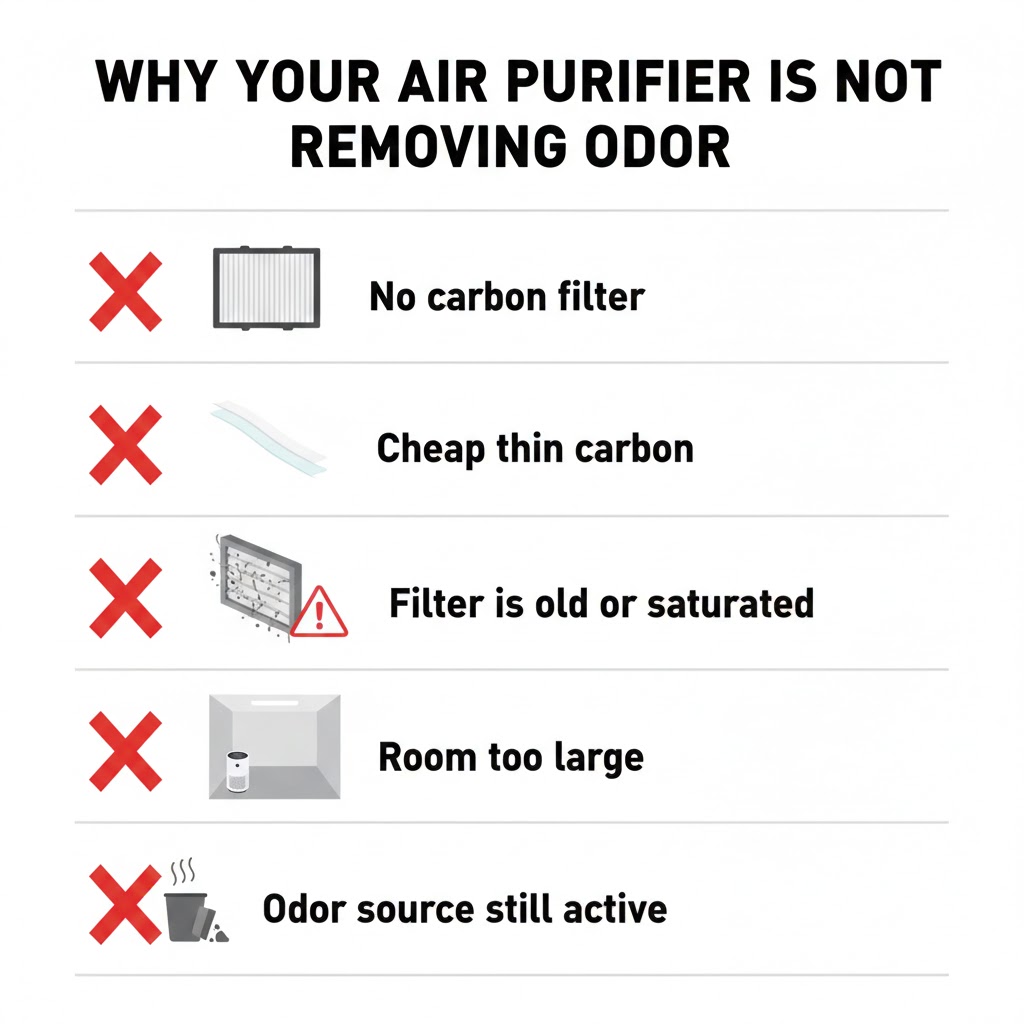
An undersized purifier may struggle to remove odors efficiently.
Higher airflow allows more air to pass through the filters.
Dirty or saturated filters are less effective at odor removal.
Air purifiers work best when the source of the smell is controlled or removed.
Watch for:
These signs often indicate that the filter needs cleaning or replacement.
No. HEPA filters remove particles but do not effectively remove odors.
Yes. Activated carbon filters are specifically designed to absorb odors and gases.
Yes, especially models with substantial activated carbon filtration.
The odor source may still be present, or the filter may be saturated.
Yes. Activated carbon filters are particularly effective for many cooking-related odors.
Air purifiers can help reduce many common household odors, but their effectiveness depends largely on the filter type. Activated carbon filters are the most important component for odor removal, while HEPA filters focus on airborne particles. For the best results, choose a purifier designed for odor control, replace filters regularly, and eliminate the source of the smell whenever possible.